
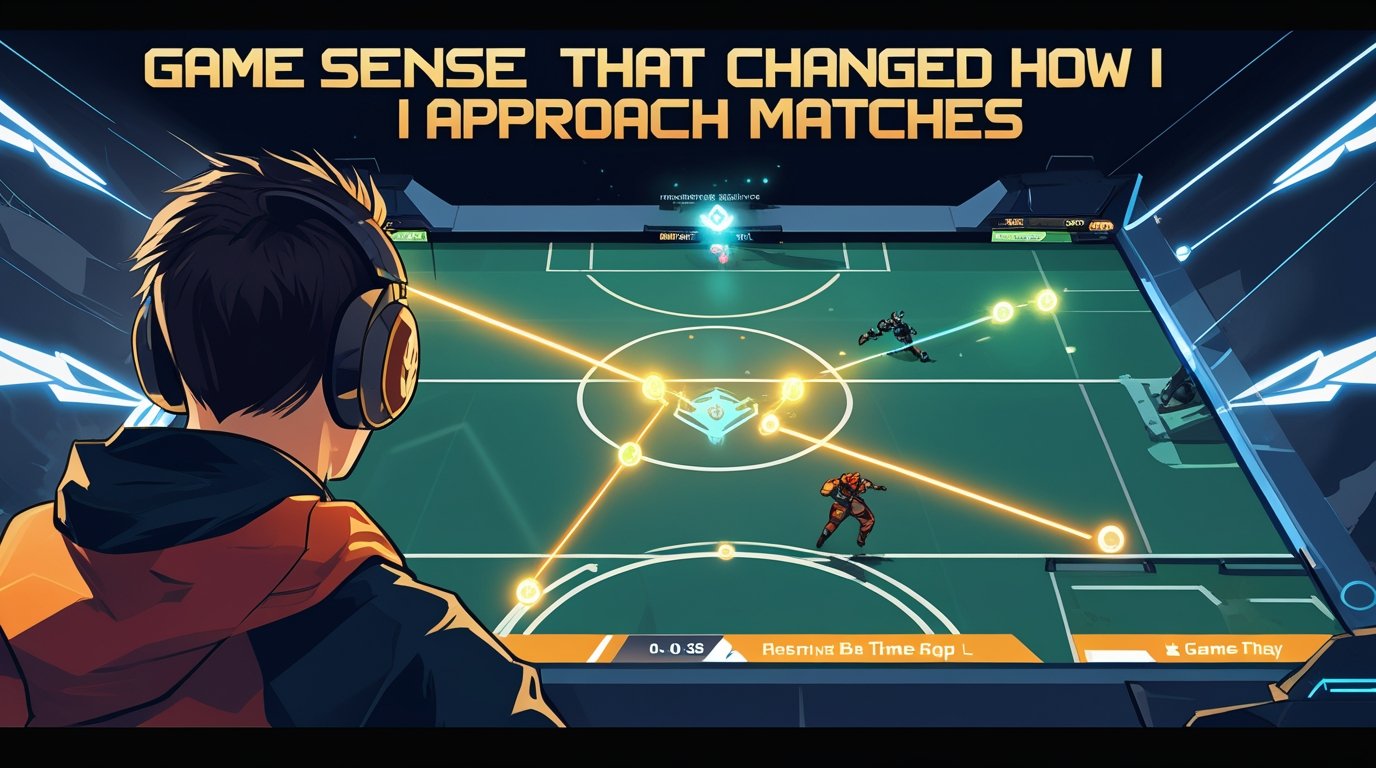
I used to have the mechanics of a semi-pro and the brain of a bronze player. I could hit flick shots in Valorant that looked great in a clip, but I’d lose rounds because I was standing in the dumbest possible place. I was a collection of reflexes with no director. I thought getting better meant my aim getting sharper, my combos getting faster. I was wrong. The single biggest leap I ever made wasn’t in my hands; it was in my head. It was developing game sense, and it turned me from a liability into a leader, from a player who reacted to the game into one who anticipated it.
The Wake-Up Call: A Humbling Spectator Mode:
The moment it clicked wasn’t a win; it was a review. My team had lost a close Counter-Strike match. We were salty, blaming luck. Our more experienced IGL (In-Game Leader) didn’t argue. He just said, “Watch the replay. From my perspective.” He streamed it.
Watching through his eyes was a revelation. While I was hyper-focused on my crosshair, he was watching the kill feed like a ticker tape. He saw two teammates die on the other side of the map and immediately called, “They’re all rotating, play for picks and delay.” I hadn’t even registered the deaths. He heard a specific gunfire sound, an AWP versus a Scout, and knew their sniper was low on ammo and vulnerable after a shot. He tracked the economy of both teams, predicting a force-buy round and adjusting our defense accordingly.
I was playing an FPS. He was playing chess with guns. My focus was a spotlight, illuminating only what was directly in front of me. His was a floodlight, taking in the entire state of the match. That was game sense: the constant, subconscious processing of information to build a predictive model of what will happen next.
Building the Mental Dashboard: From Data to Insight:
I started consciously building what I call my Mental Dashboard. I stopped letting information wash over me and started actively hunting for it. I compartmentalized the streams of data.
The Economy Ticker: This became priority one. In any round-based shooter, I now know the exact cash of my four teammates and can closely estimate the enemy’s. Before a round starts, I’m not just thinking, “Where should I go?” I’m thinking, “They lost last round, so they have 3900 max. That means at most three rifles, two SMGs, and a light utility. They can’t afford to fully execute on a site; they’ll likely try a fast, cheesy pick.” This one piece of meta-knowledge dictates everything, my positioning, my aggression, my utility use.
The Sound Map: I turned down my in-game music to zero. Sound became my radar. But it wasn’t just about hearing footsteps. It was about layering audio cues. In Apex Legends, hearing a Sheila (Rampart’s minigun) spin up in the distance isn’t just a “fight over there” marker. It’s a data point: That team is pinned down, committed, and likely using resources. Their third-party vulnerability is high in 20 seconds. The crack of a sniper shot, the shink of a heat shield, the distant pop of a Phoenix Kit, each is a note in a song telling the story of the match.
The Timeline & Spawn Clock: This was a game-changer for objective-based games. In Call of Duty Hardpoint or Overwatch Push, I stopped just fighting for the objective. I internalized the spawn cycles and map flow. I knew that if we wiped the enemy team at a specific location on the map at the 1:15 mark, their spawn would flip. So instead of piling on the point, I’d already be rotating to cut off their new, predictable path. I was playing 15 seconds in the future.
The Predictive Engine: Playing the Player, Not the Game:
This is where game sense feels like a superpower: predicting human behavior. Good players have patterns. Great players exploit them.
I remember a Rainbow Six Siege match on the map Oregon. Every single round for three rounds, their best player would break a specific, nondescript hatch on the second floor during the prep phase. It seemed minor. My game sense alarm went off. This wasn’t random; it was a setup for a late-round vertical play. In the fourth round, instead of reinforcing the standard walls, I placed a Proximity Alarm near that hatch and waited. Two minutes into the round, the alarm sounded. I was ready, pre-aimed, and won a crucial fight not because I out-aimed him, but because I out-thought him. I had moved from seeing what they did to understanding why they did it.
This extends to “reading” the enemy’s mental state. Are they playing hesitantly after losing a lead? Time to apply aggressive pressure. Are they overly aggressive after a win? Set up a crossfire trap. Game sense is as much psychology as it is tactics.
The Macro Mind: From Tactical to Strategic:
The final layer was shifting from round-by-round tactics to match-long strategy. This is most evident in MOBAs like League of Legends.
Early in my League career, I was a mid-laner who only understood “win lane.” I could get solo kills, but we’d still lose. My game sense was lane-sized. I learned to expand it to map-sized. I started tracking the enemy jungler’s pathing from their first appearance. If I saw them top-side at 3:15, I knew their buffs would respawn, and they’d likely be botside around the 7:30 mark. I’d ping my bot lane to be careful 30 seconds before. I’d watch item timings. I knew the enemy ADC was 200 gold from their big item power spike, so I’d call for a dragon fight before they backed to buy, forcing an uneven fight.
I stopped seeing my champion and started seeing my role in a five-part machine. Was my job to split-push and create pressure? To peel for our hyper-carry? To initiate fights? My decisions (farm, roam, fight) were no longer based on what was best for me, but what was best for our win condition. This is ultimate game sense: sacrificing your personal highlight reel for the strategic victory.
The Practice: How You Actually Train Your Brain:
You can’t grind game sense in a deathmatch server. I trained it by doing three things:
- VOD Review, But Not of My Plays: I’d watch the playback from the perspective of the enemy’s best player. What did they know? When did they make their move? What information did they have that I gave away?
- The “Narrative Commentary”: I started muting my Discord and doing a quiet, constant narration of my own thought process during casual matches. “Okay, two dead on our left, so they have map control there. Their sniper hasn’t been seen in 90 seconds, likely repositioning. I should play close cover until…” It forced me to articulate the subconscious.
- Playing Different Roles/Roles: I forced myself to play support, then tank, then jungle. Understanding the pressures, timings, and goals of every role gave me a holistic understanding of the match’s flow. I knew what the enemy needed to do, because I’d been in their shoes.
The Result: Calm in the Chaos:
The most noticeable change wasn’t on the scoreboard; it was in my chest. The frantic, panicked feeling in a clutch 1v3 situation vanished. It was replaced by a calm checklist. Last seen locations? Utility left? Time on the clock? Do I need to plant, or just survive? Game sense provided a roadmap through the chaos. I was no longer a passenger in the match; I was the driver, watching the road, checking the mirrors, and anticipating the turns long before they arrived.
The Final Score:
Developing game sense didn’t just make me a better player; it made the games themselves more deeply enjoyable. I was engaging with the full, rich depth the designers built, not just the surface-level shooting gallery. It transformed gaming from a test of hands into a thrilling exercise of the mind. Now, the greatest victory isn’t the “Victory” screen; it’s the moment you predict the enemy’s move so perfectly you’ve already countered it before they even decide to make it.
FAQs:
1. What’s the simplest definition of game sense?
It’s the real-time ability to read the state of a match and predict what will happen next, based on information, not just instinct.
2. Can you have good game sense with bad mechanics?
Yes, and you’ll be a valuable strategist and caller, but you’ll often lose straight duels to more mechanical players.
3. How is game sense different from map awareness?
Map awareness is seeing what’s happening; game sense is understanding why it’s happening and what will happen because of it.
4. Is game sense something you’re born with?
No, it’s a learned skill built through conscious observation, analysis, and experience across many matches.
5. What’s the fastest way to improve my game sense?
Watch your match replays from the enemy team’s perspective to see what information they had when they outplayed you.
6. Does game sense matter in single-player games?
Absolutely, it translates to understanding enemy AI patterns, resource management, and anticipating game-critical events.